
For years, Australian gin has been marketed through a single image: native botanicals, coastline air, and a laid-back urban bar scene.
But several hours inland from Brisbane, in the high country of southern Queensland, a different gin identity is emerging — one shaped not by beaches, but by frost.
Welcome to the Granite Belt.

This is Australia’s highest wine region. It’s a place where winter mornings sit below zero, where granite pushes through the soil in massive boulders, and where altitude quietly changes how things grow, ferment, and distil.
And it may be one of the most technically interesting gin regions in the Southern Hemisphere.
The Granite Belt: Australia’s Cool-Climate Outlier
The Granite Belt sits roughly 700–1,000 metres above sea level near Stanthorpe, close to the New South Wales border.
That elevation matters.
Unlike tropical Queensland stereotypes, this region experiences four distinct seasons. Winters bring frost. Summers are warm but rarely oppressive. The soil, dominated by decomposed granite, drains quickly and forces crops to work harder.
For decades, this made the region famous for:
- Cool-climate shiraz and chardonnay
- Apples, stone fruit, berries
- Boutique agricultural production
But gin was not originally part of the story.
What changed wasn’t just consumer demand.
It was technology.
Cold Distillation: The Quiet Revolution in Australian Gin
Traditional distillation relies on heat. Botanicals are exposed to high temperatures, alcohol vapours rise, and flavour compounds are captured.
Cold distillation — often using vacuum systems or rotary evaporators — works differently. By lowering pressure inside the still, alcohol boils at a much lower temperature. That means botanicals can be extracted without the aggressive heat that sometimes flattens delicate aromatics.
In practical terms, cold distillation can preserve:
- Floral top notes
- Fresh citrus brightness
- Subtle green or herbaceous tones
- Textural softness
It’s less about intensity and more about precision.
And precision suits altitude.
In a cool-climate region like the Granite Belt, where fruit and herbs develop slowly and cleanly, distillers have started asking a different question:
What if gin here didn’t need to be bold — just exact?
Diviners Distillery and the Technical Turn
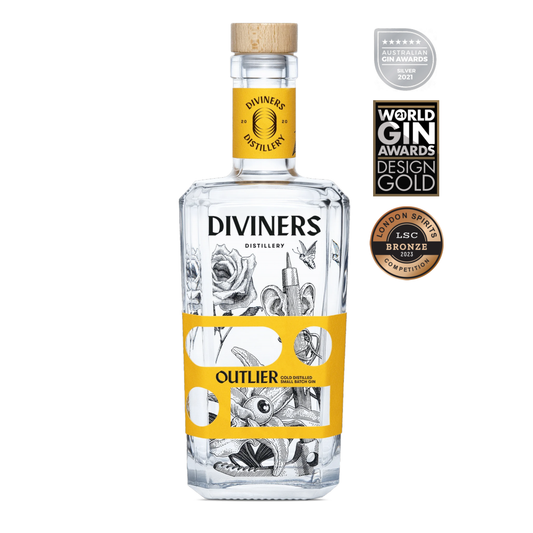
Among the producers exploring this technical edge is Diviners Distillery, based in the Granite Belt.
But what makes the story interesting isn’t simply that Diviners exists — it’s that it reflects a broader regional shift. The Granite Belt isn’t chasing Sydney or Melbourne bar culture. It’s building something quieter and more laboratory-minded.
Diviners has leaned into controlled, small-batch production and cold extraction techniques that prioritise aromatic clarity over brute botanical force. Rather than stacking native ingredients for marketing impact, the focus is on balance — structure, mouthfeel, and layered top notes that unfold gradually.
This approach aligns with the region’s agricultural discipline. Wine growers here have long worked with subtlety — adjusting to frost risk, managing yields, respecting soil expression.
Gin, in this context, becomes less about “Australian bush theatre” and more about controlled craftsmanship.
Frank Tomlinson: Precision as Philosophy
At the centre of this movement is Frank Tomlinson, founder of Diviners Distillery.
Tomlinson’s approach reflects the Granite Belt mindset: disciplined, agricultural, and process-driven. In a region where frost can destroy a year’s work and soil quality dictates long-term success, precision isn’t optional — it’s survival.
Rather than chasing the early-wave Australian gin model of maximalist native botanicals and loud branding, Tomlinson leaned into method. Cold distillation wasn’t adopted as a novelty. It was chosen as a technical tool — a way to preserve structure, maintain aromatic integrity, and express subtlety rather than overwhelm it.
His philosophy mirrors winemaking more than traditional distilling. It’s about calibration. Temperature control. Balance. Timing.
In many ways, Tomlinson represents the maturing phase of Australian gin — where the conversation shifts from “What unusual botanicals are you using?” to “How exactly are you extracting them?”
That evolution is significant.
Because the market has evolved too.
Australia’s Second Gin Identity
If coastal Australia gave the world a bright, botanical-heavy gin style, inland Queensland may be shaping its counterpoint.
This second identity is:
- Cooler in climate
- Slower in agriculture
- More technical in production
- Less image-driven, more process-led
Granite Belt gin doesn’t shout.
It expresses.
And that matters in a global gin market that has, in many places, peaked in noise.
International consumers are increasingly familiar with gin’s flavour spectrum. The novelty phase has passed. What stands out now isn’t how many botanicals are used — but how well they’re handled.
Cold distillation offers Granite Belt producers a differentiator that isn’t marketing-led but method-led.
Where Australian Gin Stands Globally
Over the past decade, Australia has become one of the most dynamic gin-producing nations in the world.
While it doesn’t compete with the UK in historical dominance or production volume, it has built a strong international reputation in the premium and craft segments. Australian gins regularly perform well in global spirits competitions, and exports to Asia, the UK, and North America have grown steadily.
The country’s first wave of craft gin focused heavily on native ingredients — lemon myrtle, finger lime, wattleseed, Tasmanian pepperberry — creating a distinctive botanical signature that differentiated Australian producers from European counterparts.
But as global gin growth stabilises, the competitive landscape is shifting.
Consumers are more educated. Back bars are more selective. The era of endless craft expansion has slowed, replaced by consolidation and refinement.
In this environment, differentiation through method and environment — not just ingredient lists — becomes powerful.
The Granite Belt fits that next phase perfectly.
Rather than competing on novelty, it competes on precision.
Rather than volume, it focuses on identity.
Gin at Altitude: Why Environment Still Wins
There’s a temptation to frame modern distilling purely as technology-driven. But in the Granite Belt, environment still shapes everything.
Altitude affects plant oils. Cool nights slow ripening. Granite soils encourage concentration.
Even with cold distillation, what enters the still determines what leaves it.
This is where Queensland’s high country distinguishes itself from Australia’s coastal gin narrative. It’s less about native spectacle and more about agricultural integrity.
Gin here feels closer to wine thinking than cocktail thinking.
That’s a subtle but important difference.
A Region Still Writing Its Story
The Granite Belt isn’t mass-producing gin. It’s building identity slowly.
Producers like Diviners Distillery — and founders like Frank Tomlinson — represent a generation that understands both tradition and innovation, respecting agricultural foundations while experimenting with vacuum systems and cold extraction.
This isn’t about replacing Australia’s established gin regions.
It’s about expanding the country’s flavour map.
If coastal gin was Australia’s first chapter, altitude gin may be the second.
And it’s being written quietly — one controlled distillation at a time.